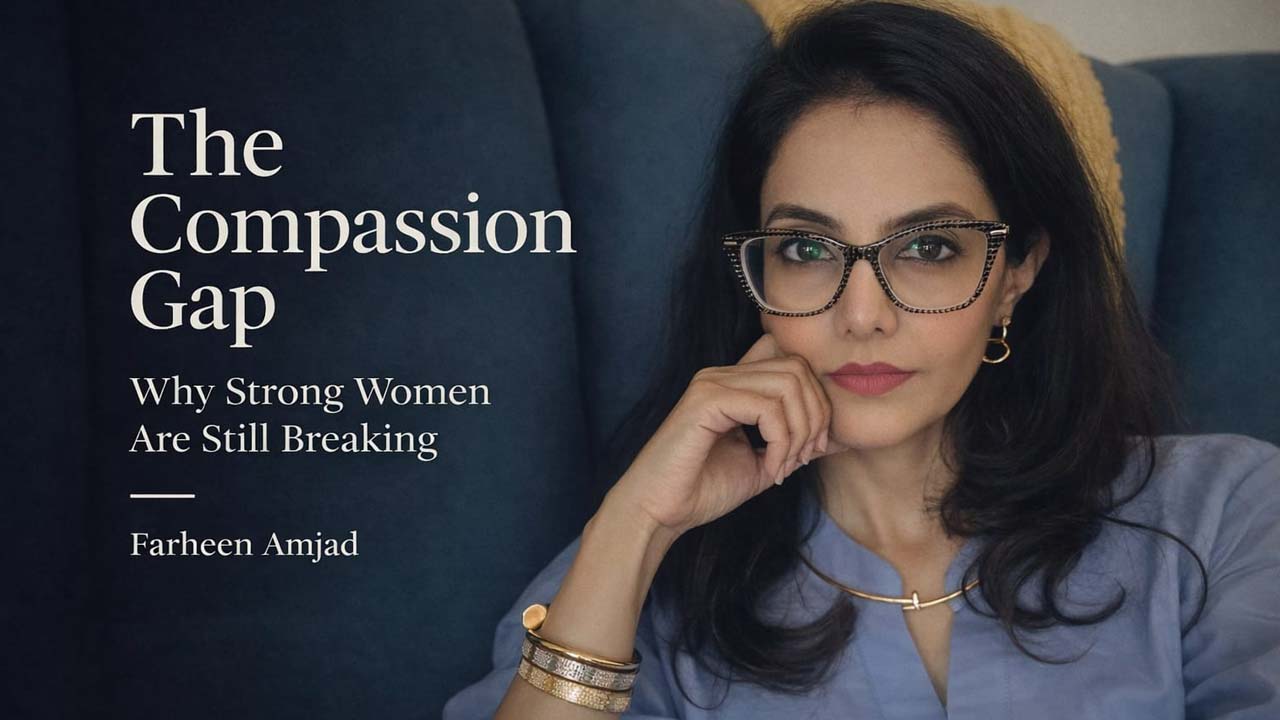
In many South Asian households, strength is seen as a defining quality of womanhood.
From an early age, girls are taught to adapt, to give, and to endure. They are appreciated for keeping families together, managing households, nurturing relationships, and increasingly, contributing financially.
Yet beneath this admiration lies a quieter, often unspoken reality:
Strength has been normalized.
Compassion has not.
The Weight of the Invisible
Across South Asia, women carry a disproportionate share of unpaid care work.
Research by UN Women indicates that in countries like India and Pakistan, women perform 7 to 10 times more unpaid domestic work than men. In Bangladesh, women spend nearly 11.7 hours each day on unpaid work, compared to just 1.6 hours for men.
These are not just numbers.
They reflect a system where effort often goes unseen and expectations never pause.
The Double Burden
As more women pursue education and careers, their responsibilities have not decreased—they have expanded.
This is commonly referred to as the “double burden.”
Women are expected to achieve professional success while continuing to manage the home as their primary responsibility.
There is no replacement of roles.
Only an addition of responsibilities.
The Emotional Cost
The impact of this imbalance is not only physical—it is deeply emotional.
According to the World Health Organization, women are more likely than men to experience depression and anxiety, particularly within South Asian communities.
Despite this, mental health remains a sensitive and often stigmatized subject.
Emotional struggles are frequently dismissed as:
Overreaction
Weakness
Ingratitude
As a result, many women continue to carry everything—silently.
Identity Under Pressure
A South Asian woman is often expected to fulfill multiple roles simultaneously:
The caregiver who never complains
The professional who never falls behind
The daughter, wife, or mother who always puts others first
And when she is unable to meet all these expectations?
She experiences guilt, judgment, and pressure.
Over time, a deeper question begins to surface:
Who is she beyond what is expected of her?
Beyond the Gender Debate
This issue is not simply about men versus women.
Men also face pressures—particularly as financial providers and family anchors.
However, the difference lies in recognition.
Men’s roles are visible and acknowledged.
Women’s roles, especially within the home, are often taken for granted.
This is not about assigning blame.
It is about achieving balance and acknowledgment.
The Misinterpretation of Strength
Women are often praised for being:
Strong
Emotionally intelligent
Natural caregivers
Over time, however, these qualities have been misinterpreted.
What began as strength has gradually become expectation.
And expectation has turned into obligation.
Closing the Compassion Gap
Change does not require dramatic disruption.
It begins with small, intentional shifts:
Recognising unpaid care work as real work
Sharing responsibilities within households
Encouraging open conversations about mental health
Promoting empathy and emotional awareness across genders
Most importantly, it requires a shift in mindset:
From admiring sacrifice
To supporting sustainability.
A Final Reflection
South Asian women have never lacked strength.
What has been missing is consistent compassion—within families, communities, and broader systems.
Until this gap is addressed:
Resilience will continue to be praised
And exhaustion will continue to be overlooked
Contact Details
Facebook: https://www.facebook.com/farheen.syed.92